Or would it be easier for you to answer, 'How often don't you train?'
You might be counting up the hours and days now and coming up with an answer along the lines of "twice per week", "4 times per week but I do a bit everyday" or even "I train every day". What I want to explore and explain here are some things that I have noticed mentioned here and there in forums and in bits and pieces of articles, but I have never found it talked about in great detail or emphasised enough to reveal it to possibly be the easiest way to improve your Parkour.
The secret to improving in this discipline quickly becomes obvious to beginners. The formula is simple; the more you practice, the better you become. So how can we practice more when our demanding lifestyles and jobs seem to swallow more and more of our time each week?
When people begin their training, they often focus on the movements that they have seen either in videos, or in person of (particularly good) traceurs, that are out of the ordinary - and why not! They look so spectacular and different. But what they all regularly fail to notice are the movements that they, themselves, already do every day, also being done in a superior way in front of their eyes.
I was lucky enough to be invited along to a gym session earlier this week, near to where I live, to teach, answer questions and offer advice to a group of perhaps 25, 10-18 year olds who had been training for various amounts of time. Some had just started, others had perhaps two years or more training behind them already.
One of the things that I realised quite quickly is that everybody who asked for advice, asked how to do a particular part of a technique better, or for advice on a specific moment of the movement, but nobody asked what to do before the movement, after the movement or what to do whilst in the air.
It got me thinking back to when I started and I was exactly the same. I would focus on the split second of spectacular action when I watched a movement. Whether it was the contact of hands on the wall, the clearing of a rail or the moment where the hands grabbed a branch. That was the impressive part for me and the part I was trying to learn. I wasn't even considering the foot placement for the run up, my posture in the air or the landing.
At the session, nobody asked me how to land after a cat pass or how to begin the run up - only how to do the cat pass itself when they reach the obstacle. Which was interesting. This is completely normal and I'm glad it happened because it encouraged me to write this article and taught me a lot about my own progression and training.
I've mentioned before how frequently that I find people who have been practicing for a year or two who think they are very good now and mastering techniques, ready for bigger, higher, further challenges. But it is only after those first few years that people begin to appreciate just just how deep the Parkour root grows, underground, hidden where you cannot see it at first.
Over time I have come to realise that from the moment I begin my run up for a jump, every single step, swing of the arm and intake of air, up until the moment I stop moving after the obstacle(s), is a part of the technique I am doing and should be treated with equal importance. This is why precision and perfection is so important to me and why I repeat things over and over until I'm happy. The passing of the obstacle might be fine but perhaps there was a stutter in my run up or maybe I held my breath unconsciously half way through. If so, I need to do it again properly. I wouldn't consider something perfect until all of these issues are considered and addressed. Only then will I be satisfied.
I went on holiday two weeks ago with my parents and we spent a great deal of time going to different places, walking around and visiting local places of interest. Whilst out walking one evening by the beach, my mum asked me if I missed training as much as I usually do at home and she was surprised when I answered that I was training right at that moment. We were on a completely flat pavement just next to the beach with nothing that could really be considered an obstacle or obstruction for at least 100m in every direction (unless you include the sea).
She seemed confused and when I explained that I was working on my foot placement, and that when we reach that coke can around 10 metres ahead of us on the ground, I will be on my right leg, and the ball of my foot will be in line with it, she smiled and for a brief second was given a glimpse of just how deep the practice of Parkour can go. It was nice to hear her say that she never realised I trained so often. I reached the can with my right leg, ball of foot in line with it and picked it up to put in the next bin we found (for recycling, of course :P).
To get to the point, the purpose of this article is to express how I believe we can practice Parkour all day, every day. There is absolutely no excuse for not having enough time to practice, since I believe we can practice every time we 'do' anything.
Although I am not very good at this yet, lately I have been working on concentrating on my every movement, whilst doing an everyday task, such as eating, driving my car and walking around my room. I find that I can only keep this up for around ten to twenty minutes at a time before something distracts me momentarily, but that period of time is incredible. I feel more connected with my surroundings and the world in a way that is very refreshing to me. It seems to create more awareness and I feel very calm and centred during these times.
The idea is to pay more attention than usual and maintain a state of higher awareness as to what your body is doing and where you fit in to your surroundings. I was once introduced to a concept known as, 'Zanshin', through Shotokan Karate. It refers to a state of awareness - a state of relaxed alertness. I believe I have more use for this concept now in Parkour than I did practicing martial arts.
You can try this now if you like, from wherever you are reading this. Consider walking to the nearest door. What is in the way? Perhaps there are people or chairs, a bed, a ball or stairs. Walk to the door and from the time you look away from the screen, focus on every single thing. Feel the intake of air as you prepare to move, focus on each muscle contracting as you stand, with just only enough force to shift the weight of your body on to your feet. Why have your arms moved? Return them to a neutral position. Turn purposefully, using the least amount of energy possible without unnecessary movement. How many steps will you need to take until you reach the first obstacle? Plan the distance of your steps appropriately so that you know which foot will be nearest to the obstacle when you reach it, decide how to move past it, move past it and continue to repeat this process until you reach the door. Now do it again from the beginning but with predetermined thought, simply move and be aware of everything your body is doing to get there. Move slowly but smoothly to begin with. It's almost a machine-like routine. If you look at Arnold Schwarzenegger's movements in Terminator 2, everything is ruthlessly efficient and every part of him seems to be moving for a reason, with purpose. No flailing limbs, no faltering on uneven ground, no reason to move at all unless that movement has a purpose to help him to achieve his goal.
I'm not suggesting that we all walk around like robots but this is a good example of a being moving with precision and purpose. It is this precision and purposeful movement that I am trying to practice every time I move, but it is difficult. I soon forget what I'm trying to do and lose concentration a little, but each time I try it I find I can do it for a little longer than the time before.
The benefits are numerous as they are vast. Not only will you conserve energy and be less likely to get injured as you move, you will also be improving every aspect of your Parkour, as your limbs learn to move with more precision. Most of us are guilty of using too much energy to complete every day tasks. Even to open a door, most of us open it more than we need to. Stop using handrails, you don't need them. Stop using elevators and escalators, you don't need them. They rob you of the one thing that we are trying to regain here, time to practice. If you must use an elevator, push the button with only enough force to make it light up. This kind of attitude and train of thought can be carried over in to every aspect of your life. Be methodical in everything that you choose to do.
For more examples of individuals moving with precision, watch Tom Cruise in Collateral or Matt Damon in the Bourne movies. It seems that actors can be very good at being precise when they want to thanks to their study of the human body in motion.
My ultimate goal is to move with precision and purpose, all day, every day. Whether I'm lifting a pen, practicing arm jumps or shopping for... bananas. This would conserve a great deal of energy, help to avoid accidents, teach me more about my body and generally allow me to train my body for up to 16 hours per day in a way that would directly improve my Parkour. Some might even argue that this is the very essence of Parkour itself. I would be simply trying to move with efficiency and precision all of the time, with no difference in mindset between going to the bathroom and passing a rail. Both should be done with equal concentration and precision by the student who wishes to achieve their potential in controlling their body whilst it is in motion.
I like to look around me when I am out in busy streets, I look at the way people walk and I often notice people who seem less caught up in bottlenecks and less likely to bump in to someone as they are moving through the sea of people. They move with more grace than the people around them. I wonder whether they are a martial artists or a dancers perhaps... for it seems that people who spend more time focusing on their movements, even through a hobby, move more efficiently even when they are not thinking about it.
If they could be conscious of this superior grace and realise why they reached their destinations quicker than the average person then they could truly begin to progress to elite levels in their chosen fields, by simply practicing more than other people do.
Perhaps we can do the same.
-Blane

Friday, October 05, 2007


Sunday, September 09, 2007
EscApe Artist
Well it's been a while since I updated this and quite a lot had happened since the last entry. I had a fairly major training accident that saw 5 stitches in my shin to hide the bone that showed itself about a month ago.
I was doing a routine climbup on the end of a wall and some bricks fell off, I fell back and landed on my back - which was fine - but then I was really unlucky to have 3 bricks cemented together smash in to my shin, edge first, and cut my skin open all the way down to the bone.
A few hours later and after an injection that went RIGHT inside my leg next to the bone (OUCH!), I was stitched up and limping home. The timing couldn't have been worse as I missed out on the Trace Gathering that I was really looking forward to. I guess it wasn't meant to be... sorry to the people who expected me there! Thanks to Timmy, Joe and Ian for looking after me in the hospital, much appreciated.
I didn't get any photos of it before the nurse did a tidy sewing job but here's the morning after...


Besides that I've been filming some new clips and slowly making a new video. It all came together tonight, just in time for my 4th year anniversary of training.
The four years have flown past at a scary speed and so much has happened in that time. I wish to thank everyone I've met through this amazing discipline, every one of you have helped to shape me in to who I am today and for that I'm very grateful.
I'll be quiet now and show you the video, I hope you enjoy it...
Apologies to everyone that has emailed me or posted on my blog recently and not got a reply yet, I've not had as much time on the Internet to browse through them recently but I'll answer them all this week, thanks for your patience!
-Blane
I was doing a routine climbup on the end of a wall and some bricks fell off, I fell back and landed on my back - which was fine - but then I was really unlucky to have 3 bricks cemented together smash in to my shin, edge first, and cut my skin open all the way down to the bone.
A few hours later and after an injection that went RIGHT inside my leg next to the bone (OUCH!), I was stitched up and limping home. The timing couldn't have been worse as I missed out on the Trace Gathering that I was really looking forward to. I guess it wasn't meant to be... sorry to the people who expected me there! Thanks to Timmy, Joe and Ian for looking after me in the hospital, much appreciated.
I didn't get any photos of it before the nurse did a tidy sewing job but here's the morning after...


Besides that I've been filming some new clips and slowly making a new video. It all came together tonight, just in time for my 4th year anniversary of training.
The four years have flown past at a scary speed and so much has happened in that time. I wish to thank everyone I've met through this amazing discipline, every one of you have helped to shape me in to who I am today and for that I'm very grateful.
I'll be quiet now and show you the video, I hope you enjoy it...
Apologies to everyone that has emailed me or posted on my blog recently and not got a reply yet, I've not had as much time on the Internet to browse through them recently but I'll answer them all this week, thanks for your patience!
-Blane
Friday, July 13, 2007
First clip of a OAC
Here's a quick clip showing my first filmed one-armed chinup. They're progressing not too badly but I've been focusing on other things recently. I'm currently able to do 2 on my left arm and 1 on my right when I'm fresh and I'm working on building up to 5 on each arm.
-Blane
-Blane
Thursday, June 21, 2007
The Descent
Following on from my previous post and the discussions that concluded it, I'm staying on a similar track with this one and I want to talk about how pressure can affect us when we face danger and how we can deal with that pressure by making simple decisions right now, that will increase our chances of survival.
When faced with the stress of a life-threatening engagement, we don't rise to the occasion, we descend to our level of training.
I think this is very important for everyone involved in a discipline such as our own or even martial arts to consider - and I wanted to share it with everyone that reads my blog.
If you don't think your training is thorough in preparing you to save your life and escape from dangerous scenarios then perhaps there are some things in this entry that might help you - and if you do think that your training is thorough enough then I really would appreciate your input so please leave a comment after reading this.
As some of you will know, my current understanding and practice of Parkour is different to some other people's and I really see Parkour as being much more than simply the movements we see in so many videos... I believe Parkour is about being strong in every sense of the word and being able to survive when the going gets tough which is why my studies extend beyond that of learning how to move efficiently.
To quote my friend Thomas Couetdic,
You can read some more of Thomas' thoughts here but it is this 'extreme' mentioned above that I am following and interested in discussing in this post.
Most of the time we train in comfortable environments, perhaps with friends, not really in any more danger than we put ourselves in. In these circumstances we can put all of our focus and attention in to our techniques and movements without having to worry about any other danger such as coping with the chemical changes in the body that occur when we are faced with danger.
When we are faced with the stress of a life-threatening situation, our body's natural defenses are engaged and frankly most of us, myself included, are not prepared for this.
Here in the Western world, we have become a generation of protected individuals; protected by law enforcement, CCTV, prison systems, physical deterrences and satellites. It's easy to become complacent under these circumstances but all of today's and tomorrow's technology cannot (yet?) change human nature. There will always be murder, theft, rape and crime in general, not to mention natural disasters - and this is why I find it's important to always be aware of our surroundings and to prepare for dangerous situations. But the likelihood of us preparing for these things are slim until we've experienced them for ourselves. It is not until we have become a victim ourselves that we realise that we are not as protected as we think and I think we need to make more of an individual effort to train ourselves more thoroughly.
All of our modern-day advantages become truly useless when we are faced with danger. We even forget all about our family and friends (unless they are directly involved) and what might scare you is that we also forget a significant portion of our training in a crisis.
When we have plenty of time to think and plan and calculate, we are capable of amazing things during our training sessions. We can use our experience and physical ability to decide on the best course of action to tackle a new obstacle but this generally takes some time to take everything in to account and plan the new jump. But what if we remove that period of time from the equation?
If we were being chased by a crazy man with an axe who was trying to kill us, our best chance of survival would be to put a worthy obstacle between ourselves and the man, be that a large wall, a drop that he would struggle to take without breaking a leg or a massive arm jump over a ravine. The bottom line is, an experienced traceur would have the best chance of survival if they could employ their training and experience effectively.
However, the techniques that we are still trying to perfect, the ones we haven't done thousands of times before are immediately considered unreliable by the brain and therefore are not instinctual in our escape process, we can't naturally do them without thinking about it.
Now if we were chased by this psycho in a place we knew, a place we trained at every week and a place we were comfortable moving in then the chances are we would escape. We already know the distances, surfaces, loose bricks and paths to escape and all we would have to do is feed off of the adrenaline to heighten our senses and try to stay calm to some extent to allow our training to be useful.
Now I think we would all agree that these chances are significantly reduced in an unfamiliar environment but there are things we can do to overall improve our chances of survival in these new circumstances, besides regularly drilling the usual techniques in new areas.
So how can we replicate these conditions to prepare for these situations? It is very difficult but it seems possible to some extent since some martial arts, such as Krav Maga, attempt to prepare the student of their combat system more effectively by simulating more realistic situations than a dojo, such as sparring in a darkened room with flashing lights and deafening music. This simulates a nightclub, where there is obviously the potential for danger and gives the student experience in defending themselves in a situation where it is likely to be necessary.
We can't force the body to release adrenaline when we know it is only our friend chasing us when we play tag, but things like this can help you learn how to stay calm under pressure and to act when there is someone behind you putting pressure on you.
Here is an example of a good training session you could have to prepare for a potentially life-threatening situation:
Get a friend to get a big black permanent marker pen and get him to chase you, trying to draw on you... this might sound really funny and I laughed when I thought of it, but this is fairly effective training for escaping someone with a knife, a situation where you couldn't afford to be hit even once. At the end of the game, if you have any ink on you then your peruser could have potentially stabbed or slashed you in that location.
You might think this will be easy for the pursuer since he only has to hit you once but think of the advantages you have! Unless they can do a one-armed climbup, which probably results in less than 2% of the entire world population, then a simple medium sized wall pass would be sufficient in slowing down your friend as they will have to put the pen in their pocket or attempt to struggle over whilst still holding the pen.
The great thing is, the majority of the population are not trained for overcoming obstacles so if you can escape your traceur friend, you can easily escape a random thug.
With this simple experiment we can experience how a knife gives a pursuer at least one major and immediate disadvantage during a chase. It is experience like this that can give us the confidence to remain calm in a real life-threatening situation as we know first-hand the likely benefits you are going to have as you flee. It is all well and good to simply read these things but go out and try it so you experience it rather than imagine it.
Without this type of training and others like it, I believe we are severely limiting ourselves and lying to ourselves that our training is thoroughly preparing us for the day we may have to save our lives.
'We descend to our level of training' is the key to my earlier statement since our brain's will disregard anything that it considers unreliable and untested. Any 'maybes' will be considered not worth trying and we will be left with a very watered down version of our level.
By training in more realistic scenarios we can succeed in turning more 'maybes' in to facts, that the brain will have confidence employing if/when the time comes to put it in to action.
There is another problem that lies in the brain having too many options! You may have perhaps 5 different techniques that you consider effective in passing an average height hand-rail so how can you pick one in a crisis over another? Can you do that quickly if you haven't already thought about the possible consequences? Are you certain that you will just be able to adapt to the situation and pick a technique at the time?
What if you can't..?
Many hand-to-hand combat experts have recommended learning as many combat techniques as possible to prepare for every eventuality - but many of the same experts also recommend spending time deciding on simply 3-4 different techniques that you are certain you can execute with adequate power, speed and confidence to end the confrontation... so that you're not faced with the 3,000 techniques you learnt in the dojo running through your mind and trying to pick one in the heat of the moment.
I think it is in times of safety that we must consider these things logically so that we don't have to suddenly make the decision under pressure. Don't give the brain so many options as this causes it to panic - give it solid, concrete decisions and training based on previous logical thought so that it can lose all doubt in your ability to successfully employ this technique to save your life. Your brain has enough jobs to do during a crisis as it's trying to manage chemicals, muscles, oxygen intake etc. Give it one less thing to worry about, today.
Decide now which ONE pass you can use most effectively when faced with the average hand-rail so that when the time comes you're not faced with such thoughts as, "SHALL I CAT? SPEED? JUMP OVER?!" as you approach the obstacle.
These decisions today, might just save your life tomorrow, as you descend to your level of training.
-Blane
When faced with the stress of a life-threatening engagement, we don't rise to the occasion, we descend to our level of training.
I think this is very important for everyone involved in a discipline such as our own or even martial arts to consider - and I wanted to share it with everyone that reads my blog.
If you don't think your training is thorough in preparing you to save your life and escape from dangerous scenarios then perhaps there are some things in this entry that might help you - and if you do think that your training is thorough enough then I really would appreciate your input so please leave a comment after reading this.
As some of you will know, my current understanding and practice of Parkour is different to some other people's and I really see Parkour as being much more than simply the movements we see in so many videos... I believe Parkour is about being strong in every sense of the word and being able to survive when the going gets tough which is why my studies extend beyond that of learning how to move efficiently.
To quote my friend Thomas Couetdic,
I believe that Parkour, however wide it may be, is not a discipline in itself, but a piece of a bigger thing. If you follow the idea of Parkour (at least as it was when i got into it) to the extreme (being able to save your skin from any dangerous situation), then you should not only train to jump, run, climb, etc... You should also be learning about survival techniques, escape techniques, fighting, and things like this.
You can read some more of Thomas' thoughts here but it is this 'extreme' mentioned above that I am following and interested in discussing in this post.
Most of the time we train in comfortable environments, perhaps with friends, not really in any more danger than we put ourselves in. In these circumstances we can put all of our focus and attention in to our techniques and movements without having to worry about any other danger such as coping with the chemical changes in the body that occur when we are faced with danger.
When we are faced with the stress of a life-threatening situation, our body's natural defenses are engaged and frankly most of us, myself included, are not prepared for this.
Here in the Western world, we have become a generation of protected individuals; protected by law enforcement, CCTV, prison systems, physical deterrences and satellites. It's easy to become complacent under these circumstances but all of today's and tomorrow's technology cannot (yet?) change human nature. There will always be murder, theft, rape and crime in general, not to mention natural disasters - and this is why I find it's important to always be aware of our surroundings and to prepare for dangerous situations. But the likelihood of us preparing for these things are slim until we've experienced them for ourselves. It is not until we have become a victim ourselves that we realise that we are not as protected as we think and I think we need to make more of an individual effort to train ourselves more thoroughly.
All of our modern-day advantages become truly useless when we are faced with danger. We even forget all about our family and friends (unless they are directly involved) and what might scare you is that we also forget a significant portion of our training in a crisis.
When we have plenty of time to think and plan and calculate, we are capable of amazing things during our training sessions. We can use our experience and physical ability to decide on the best course of action to tackle a new obstacle but this generally takes some time to take everything in to account and plan the new jump. But what if we remove that period of time from the equation?
If we were being chased by a crazy man with an axe who was trying to kill us, our best chance of survival would be to put a worthy obstacle between ourselves and the man, be that a large wall, a drop that he would struggle to take without breaking a leg or a massive arm jump over a ravine. The bottom line is, an experienced traceur would have the best chance of survival if they could employ their training and experience effectively.
However, the techniques that we are still trying to perfect, the ones we haven't done thousands of times before are immediately considered unreliable by the brain and therefore are not instinctual in our escape process, we can't naturally do them without thinking about it.
Now if we were chased by this psycho in a place we knew, a place we trained at every week and a place we were comfortable moving in then the chances are we would escape. We already know the distances, surfaces, loose bricks and paths to escape and all we would have to do is feed off of the adrenaline to heighten our senses and try to stay calm to some extent to allow our training to be useful.
Now I think we would all agree that these chances are significantly reduced in an unfamiliar environment but there are things we can do to overall improve our chances of survival in these new circumstances, besides regularly drilling the usual techniques in new areas.
So how can we replicate these conditions to prepare for these situations? It is very difficult but it seems possible to some extent since some martial arts, such as Krav Maga, attempt to prepare the student of their combat system more effectively by simulating more realistic situations than a dojo, such as sparring in a darkened room with flashing lights and deafening music. This simulates a nightclub, where there is obviously the potential for danger and gives the student experience in defending themselves in a situation where it is likely to be necessary.
We can't force the body to release adrenaline when we know it is only our friend chasing us when we play tag, but things like this can help you learn how to stay calm under pressure and to act when there is someone behind you putting pressure on you.
Here is an example of a good training session you could have to prepare for a potentially life-threatening situation:
Get a friend to get a big black permanent marker pen and get him to chase you, trying to draw on you... this might sound really funny and I laughed when I thought of it, but this is fairly effective training for escaping someone with a knife, a situation where you couldn't afford to be hit even once. At the end of the game, if you have any ink on you then your peruser could have potentially stabbed or slashed you in that location.
You might think this will be easy for the pursuer since he only has to hit you once but think of the advantages you have! Unless they can do a one-armed climbup, which probably results in less than 2% of the entire world population, then a simple medium sized wall pass would be sufficient in slowing down your friend as they will have to put the pen in their pocket or attempt to struggle over whilst still holding the pen.
The great thing is, the majority of the population are not trained for overcoming obstacles so if you can escape your traceur friend, you can easily escape a random thug.
With this simple experiment we can experience how a knife gives a pursuer at least one major and immediate disadvantage during a chase. It is experience like this that can give us the confidence to remain calm in a real life-threatening situation as we know first-hand the likely benefits you are going to have as you flee. It is all well and good to simply read these things but go out and try it so you experience it rather than imagine it.
Without this type of training and others like it, I believe we are severely limiting ourselves and lying to ourselves that our training is thoroughly preparing us for the day we may have to save our lives.
'We descend to our level of training' is the key to my earlier statement since our brain's will disregard anything that it considers unreliable and untested. Any 'maybes' will be considered not worth trying and we will be left with a very watered down version of our level.
By training in more realistic scenarios we can succeed in turning more 'maybes' in to facts, that the brain will have confidence employing if/when the time comes to put it in to action.
There is another problem that lies in the brain having too many options! You may have perhaps 5 different techniques that you consider effective in passing an average height hand-rail so how can you pick one in a crisis over another? Can you do that quickly if you haven't already thought about the possible consequences? Are you certain that you will just be able to adapt to the situation and pick a technique at the time?
What if you can't..?
Many hand-to-hand combat experts have recommended learning as many combat techniques as possible to prepare for every eventuality - but many of the same experts also recommend spending time deciding on simply 3-4 different techniques that you are certain you can execute with adequate power, speed and confidence to end the confrontation... so that you're not faced with the 3,000 techniques you learnt in the dojo running through your mind and trying to pick one in the heat of the moment.
I think it is in times of safety that we must consider these things logically so that we don't have to suddenly make the decision under pressure. Don't give the brain so many options as this causes it to panic - give it solid, concrete decisions and training based on previous logical thought so that it can lose all doubt in your ability to successfully employ this technique to save your life. Your brain has enough jobs to do during a crisis as it's trying to manage chemicals, muscles, oxygen intake etc. Give it one less thing to worry about, today.
Decide now which ONE pass you can use most effectively when faced with the average hand-rail so that when the time comes you're not faced with such thoughts as, "SHALL I CAT? SPEED? JUMP OVER?!" as you approach the obstacle.
These decisions today, might just save your life tomorrow, as you descend to your level of training.
-Blane
Wednesday, May 30, 2007
2,400 - The magical number of repetitions
This short entry is just to express some of my opinions on repetition.
2,400... That's how many repetitions it takes for a movement to become instinctual (according to experts who worked with the British SAS to determine how much training they needed in certain combat techniques).
Now this might not sound like too much hard work - most of you reading this are probably now pondering whether they have done over 2,400 cat passes, 2,400 arm jumps and 2,400 metres of balancing on a rail etc. But what we have to remember is that every single obstacle is slightly different.
Think of every cat pass you have ever done and I'll bet you cannot think of two that were absolutely identical. Take in to account the approach, the heights, the widths, the distances, the weather, the dust, the humidity, the cuts on your hands at the time, the lunch you had to affect your weight and it is very unlikely that you have ever done two identical cat passes on different obstacles (or even the same one!).
So these magical 2,400 repetitions suddenly seem not so simple to complete.
According to those experts' findings based on a LOT of research, an SAS soldier in training would have to repeat a particular knife attack technique 2,400 times before it was drilled in to them and an instinctual reaction. This couldn't be done in a day since this relies on the soldier being fresh and perfectly executing the techinque whilst under realistic training conditions and in the mindset of actually killing someone.
So to bring this to the interest of us, the traceurs, this would mean that just ONE movement on ONE obstacle would need to be repeated 2,400 times whilst you were fresh and completely focused, before that ONE movement on that ONE obstacle might be considered an instinctual movement!
This hammers home the point of repetition being key, something that we've all heard from Parkour veterans time and time again but perhaps we fail to fully comprehend the messages' magnitude.
I'm sure I've done over 2,400 repetitions of every type of pass that I practice but I honestly don't think I could say I've done that amount on one obstacle whilst I was fresh and fully focused in the mindset of doing it to save my life. In fact, I know I haven't.
So for anybody who thinks they have 'mastered' a particular technique, it might come as a surprise to hear this is almost impossible since it would require around 2,400 repetitions of the technique on every single obstacle, ever created plus every one being created every day... not to mention the maintenance of that perfection.
I believe a man could spend an entire lifetime training just one technique on one obstacle and never develop it to the level of every one being 100% perfect without exception. Which is why it's funny to read lists of techniques on forums that people have 'mastered' in their first month of Parkour.
But don't worry or become disheartened with never being able to perfect your favourite technique - strive towards perfection by all means - but just remember that you can only ever finish somewhere on the path towards perfection, never at the destination itself.
There is always room for improvement.
-Blane
2,400... That's how many repetitions it takes for a movement to become instinctual (according to experts who worked with the British SAS to determine how much training they needed in certain combat techniques).
Now this might not sound like too much hard work - most of you reading this are probably now pondering whether they have done over 2,400 cat passes, 2,400 arm jumps and 2,400 metres of balancing on a rail etc. But what we have to remember is that every single obstacle is slightly different.
Think of every cat pass you have ever done and I'll bet you cannot think of two that were absolutely identical. Take in to account the approach, the heights, the widths, the distances, the weather, the dust, the humidity, the cuts on your hands at the time, the lunch you had to affect your weight and it is very unlikely that you have ever done two identical cat passes on different obstacles (or even the same one!).
So these magical 2,400 repetitions suddenly seem not so simple to complete.
According to those experts' findings based on a LOT of research, an SAS soldier in training would have to repeat a particular knife attack technique 2,400 times before it was drilled in to them and an instinctual reaction. This couldn't be done in a day since this relies on the soldier being fresh and perfectly executing the techinque whilst under realistic training conditions and in the mindset of actually killing someone.
So to bring this to the interest of us, the traceurs, this would mean that just ONE movement on ONE obstacle would need to be repeated 2,400 times whilst you were fresh and completely focused, before that ONE movement on that ONE obstacle might be considered an instinctual movement!
This hammers home the point of repetition being key, something that we've all heard from Parkour veterans time and time again but perhaps we fail to fully comprehend the messages' magnitude.
I'm sure I've done over 2,400 repetitions of every type of pass that I practice but I honestly don't think I could say I've done that amount on one obstacle whilst I was fresh and fully focused in the mindset of doing it to save my life. In fact, I know I haven't.
So for anybody who thinks they have 'mastered' a particular technique, it might come as a surprise to hear this is almost impossible since it would require around 2,400 repetitions of the technique on every single obstacle, ever created plus every one being created every day... not to mention the maintenance of that perfection.
I believe a man could spend an entire lifetime training just one technique on one obstacle and never develop it to the level of every one being 100% perfect without exception. Which is why it's funny to read lists of techniques on forums that people have 'mastered' in their first month of Parkour.
But don't worry or become disheartened with never being able to perfect your favourite technique - strive towards perfection by all means - but just remember that you can only ever finish somewhere on the path towards perfection, never at the destination itself.
There is always room for improvement.
-Blane
Monday, May 21, 2007
Pulling Power and Diet Update
Well the one-armed chinups are coming along. I have done a few on my right (weaker) arm but they're not consistent yet and I need to be 100% fresh to do them. With a bit more work I should be able to get it up to the level of the left arm with which I can do a repetition and a slow negative with relative ease.
When I first started training these I was also working towards a one-armed pullup, which I abandoned since I didn't want to overload myself. I was therefore surprised to find that I could do a one-armed pullup with my left arm with no additional training. It seems the muscles built to achieve the one-armed chinups were enough to allow me to do the same with a pronated grip. I'm really happy with this since I was thinking this would be another while down the line and require specialised training.
So as it stands I can pullup and chinup with my left arm consistently and chinup with my right arm when I'm fresh... the obvious next step is to work towards being able to chinup and pullup on both arms individually, whenever I please.
Once I have achieved this benchmark in pulling power them I'm going to cease progressing with it for a while and just maintain that level, whilst switching my focus to pushing power in the form of handstand practice, elephant lifts, weighted pushups for endurance, gymnastics planche and ultimately in this period, 10 one-armed pushups per arm with perfect form (feet together, body straight).
My leg progression is going well too, I've implemented a few new training techniques in to my leg training such as isometric holds similar to martial arts stances, jump repetitions, weighted pistols and generally focusing on jumping ability in my technical sessions.
One thing that I've been really happy with recently is my diet. It has always been 'ok' in that 5 or 6 days per week I was completely strict with what I ate and then at the weekend I tended to splurge a little and indulge myself. But recently, in the last two or three weeks I've been completely aware and careful with what I put in my mouth and I've noticed a big difference in my ability as a result.
My diet over the past three weeks has consisted of fruit (ridiculous amounts), vegetables, chicken, turkey, soup, wholemeal bread, pasta, rice, potatoes, fish, weetabix, oats, yogurt, nuts and that's pretty much all I can think of. I've been drinking water, milk and fruit smoothies/juice exclusively. That is all that I've consumed and I feel a lot better for it, I think I've lowered my body fat percentage further than ever before and I never feel bloated or hungry anymore... all of the processed chemicals seemed to be gone from my body and it feels good to be in control of the situation (I still supplement with whey protein, cod liver oil, glucosamine sulphate and a multivitamin).
I've never counted calories or weighed my meals and I don't plan to start now - I prefer to just listen to my body. The occasional cravings for something sweet or chocolaty still happen at the weekend but so far I've resisted and gradually my palette is changing. I'm going to try for two months without anything 'bad' in my diet then hopefully I'll be fully converted to healthy eating and lose the cravings for sweet foods!
Hope you're all training hard and seeing lots of progression, I'm off to eat an apple or four. ;-)
-Blane
When I first started training these I was also working towards a one-armed pullup, which I abandoned since I didn't want to overload myself. I was therefore surprised to find that I could do a one-armed pullup with my left arm with no additional training. It seems the muscles built to achieve the one-armed chinups were enough to allow me to do the same with a pronated grip. I'm really happy with this since I was thinking this would be another while down the line and require specialised training.
So as it stands I can pullup and chinup with my left arm consistently and chinup with my right arm when I'm fresh... the obvious next step is to work towards being able to chinup and pullup on both arms individually, whenever I please.
Once I have achieved this benchmark in pulling power them I'm going to cease progressing with it for a while and just maintain that level, whilst switching my focus to pushing power in the form of handstand practice, elephant lifts, weighted pushups for endurance, gymnastics planche and ultimately in this period, 10 one-armed pushups per arm with perfect form (feet together, body straight).
My leg progression is going well too, I've implemented a few new training techniques in to my leg training such as isometric holds similar to martial arts stances, jump repetitions, weighted pistols and generally focusing on jumping ability in my technical sessions.
One thing that I've been really happy with recently is my diet. It has always been 'ok' in that 5 or 6 days per week I was completely strict with what I ate and then at the weekend I tended to splurge a little and indulge myself. But recently, in the last two or three weeks I've been completely aware and careful with what I put in my mouth and I've noticed a big difference in my ability as a result.
My diet over the past three weeks has consisted of fruit (ridiculous amounts), vegetables, chicken, turkey, soup, wholemeal bread, pasta, rice, potatoes, fish, weetabix, oats, yogurt, nuts and that's pretty much all I can think of. I've been drinking water, milk and fruit smoothies/juice exclusively. That is all that I've consumed and I feel a lot better for it, I think I've lowered my body fat percentage further than ever before and I never feel bloated or hungry anymore... all of the processed chemicals seemed to be gone from my body and it feels good to be in control of the situation (I still supplement with whey protein, cod liver oil, glucosamine sulphate and a multivitamin).
I've never counted calories or weighed my meals and I don't plan to start now - I prefer to just listen to my body. The occasional cravings for something sweet or chocolaty still happen at the weekend but so far I've resisted and gradually my palette is changing. I'm going to try for two months without anything 'bad' in my diet then hopefully I'll be fully converted to healthy eating and lose the cravings for sweet foods!
Hope you're all training hard and seeing lots of progression, I'm off to eat an apple or four. ;-)
-Blane
Wednesday, May 02, 2007
Planche Progression
Just a quick post to say I managed 21 muscle ups (planche) tonight in one set.
It's been a long while since I went for my max number of repetitions and I shouldn't really have tried it tonight since I had an extreme arm session last night... I think I could have got 25 if i had been fresh.
So that's a goal for the next little while, to push my maximum muscle up repetitions in one set up to the 25-30 mark.
I've still not managed a full one-armed chin up with my right arm yet but my left arm ones are now quite consistant - I think I'll start with weighted negative repetitions to help my overall control with them.
-Blane
It's been a long while since I went for my max number of repetitions and I shouldn't really have tried it tonight since I had an extreme arm session last night... I think I could have got 25 if i had been fresh.
So that's a goal for the next little while, to push my maximum muscle up repetitions in one set up to the 25-30 mark.
I've still not managed a full one-armed chin up with my right arm yet but my left arm ones are now quite consistant - I think I'll start with weighted negative repetitions to help my overall control with them.
-Blane
Monday, April 16, 2007
Bananaman Joins The OAC Club
Firstly, I wish to thank everyone who visited my blog over the past couple of weeks and left comments on my article. The amount of feedback was very unexpected and I'm really glad the post had such a positive impact on so many people in the community. For those who contacted me via Email, Myspace, Youtube, by phone and in person regarding the article, I appreciated all of your kind words. Thanks also to the various organisations who contacted me asking to publish the article on their respective websites, it helped spread the word.
Just a quick update on my training:
Some of you may be familiar with Bananaman, the fictional schoolboy also known as Eric, who turns in to a superhero when he eats a banana. If you are not, please click here.
"...For when Eric eats a banana, an amazing transformation occurs. Eric is Bananaman. Ever alert for the call to action."
I reached one of my training goals yesterday by completing a one-armed chin up through the full range of motion. My secret? Just like Eric, all it took was a banana!
Half-way through the session I took a quick break from training on this new scaffolding tower, had a drink, peeled a banana and took a bite... with the banana still in my right hand I walked around a bit and jumped up to grab a horizontal bar with my left hand. I started pulling and for the first time, didn't stop until my chin was right over the bar. It must have been a funny sight to see my face straining, chewing, smiling and laughing at the same time whilst waving this half-eaten banana around, but it was worth it.
I did 3 complete repetitions throughout the rest of the day and plenty of partial repetitions. Although I could only do a complete one with my left arm, I'm sure the right arm isn't too far behind as I can also do 90% of one with that arm and it felt a little closer than ever yesterday.
So if ever there was a secret to breaking through that barrier and achieving something that is just beyond your reach, think of Eric and consider a banana might be the solution...
The one-armed chin ups have been on my mind since I last visited Lisses and met Thomas Des Bois for the first time. He inspired me to begin training for them and I began the process on Monday 19th February 2007. I started using a belt around my chin up bar and used that to support the pulling arm. This, combined with slow negative repetitions formed the basis for my training and I set a goal to complete one complete repetition with each arm by 1st May 2007. I now have 14 days to complete one with my right arm to meet my goal.
And this was not the end of my banana-powered adventures for the day, later on I rescued a football from a tall tree that some guys in the park kicked a little too hard. I believe that if everybody in the world completed just one random act of kindness everyday then the world would be a much better place. Whether this is helping an old lady cross the road, retrieving a ball from a roof or pushing a old man and his wheelchair up a steep hill (Nice one Jin - hahaha), we should be using our skills and training experience to aid others as well as ourselves.
Tune in next week for more adventures of Bananaman!
-Blane
Just a quick update on my training:
Some of you may be familiar with Bananaman, the fictional schoolboy also known as Eric, who turns in to a superhero when he eats a banana. If you are not, please click here.
"...For when Eric eats a banana, an amazing transformation occurs. Eric is Bananaman. Ever alert for the call to action."
I reached one of my training goals yesterday by completing a one-armed chin up through the full range of motion. My secret? Just like Eric, all it took was a banana!
Half-way through the session I took a quick break from training on this new scaffolding tower, had a drink, peeled a banana and took a bite... with the banana still in my right hand I walked around a bit and jumped up to grab a horizontal bar with my left hand. I started pulling and for the first time, didn't stop until my chin was right over the bar. It must have been a funny sight to see my face straining, chewing, smiling and laughing at the same time whilst waving this half-eaten banana around, but it was worth it.
I did 3 complete repetitions throughout the rest of the day and plenty of partial repetitions. Although I could only do a complete one with my left arm, I'm sure the right arm isn't too far behind as I can also do 90% of one with that arm and it felt a little closer than ever yesterday.
So if ever there was a secret to breaking through that barrier and achieving something that is just beyond your reach, think of Eric and consider a banana might be the solution...
The one-armed chin ups have been on my mind since I last visited Lisses and met Thomas Des Bois for the first time. He inspired me to begin training for them and I began the process on Monday 19th February 2007. I started using a belt around my chin up bar and used that to support the pulling arm. This, combined with slow negative repetitions formed the basis for my training and I set a goal to complete one complete repetition with each arm by 1st May 2007. I now have 14 days to complete one with my right arm to meet my goal.
And this was not the end of my banana-powered adventures for the day, later on I rescued a football from a tall tree that some guys in the park kicked a little too hard. I believe that if everybody in the world completed just one random act of kindness everyday then the world would be a much better place. Whether this is helping an old lady cross the road, retrieving a ball from a roof or pushing a old man and his wheelchair up a steep hill (Nice one Jin - hahaha), we should be using our skills and training experience to aid others as well as ourselves.
Tune in next week for more adventures of Bananaman!
-Blane
Tuesday, April 03, 2007
Dilution
Dilution:
a) The process of making weaker or less concentratedb) A dilute or weakened condition.
c) A diluted substance.
I've not posted for a while as my mind has been busy and it's only now that I feel I want to share the outcome of my thoughts. This entry may offend you, it may seem like it's directed at you and maybe it is.
To quote Stephane Vigroux, "I think for many people it has to be more personal... everybody's moving... I'm really happy for them... but too quickly, too fast, too easy, too much show... too much."
1) If you’re new to Parkour, research as much as possible and learn from the people who have walked the path before you, but do not lose your creativity and ability to think for yourself. Try new things, explore different methods and progress at your own pace. What you need to remember is that the people before you have more physical experience that has built what I refer to as ‘granddad strength’ and that cannot be taught or passed on. You can rush the theory but you cannot take shortcuts on the practical stage if you want to last in this discipline.
2) If you are more experienced in Parkour and feel like newer people are better than you, do not feel pressured in to pushing yourself too hard or doing things just because they are. Try to warn them of the dangers of trying things beyond their bodies’ conditioned state - even if they can do something, doesn’t mean they should. They are learning faster than you due to the wealth of information before them, due to your hard work.
If you care for the future of Parkour then it is your duty to help them to progress sensibly and remind them that they should slow down when you think they are going too fast. If we do not do this, Parkour will slowly die as its practitioners become weaker and weaker duplicates of past traceurs due to injury, overtraining and joint destruction.
Are you going to help to dilute Parkour and the new traceurs, Or are you going help to concentrate it and strengthen them?
"Tread softly because you tread on my dreams." - William Butler Yeats
Monday, March 19, 2007
Lisses 2007 Video
I finally finished editing the video from the trip to Lisses.
We should have planned things a little better but ended up training hard all week then realised we hadn't filmed anything! So on the last two days we tried to capture what our bodies would allow us to do after a week of punishment.
It will mean more to the people who were there than it will to the general public but I thought I would share it with those who are interested...
-Blane
We should have planned things a little better but ended up training hard all week then realised we hadn't filmed anything! So on the last two days we tried to capture what our bodies would allow us to do after a week of punishment.
It will mean more to the people who were there than it will to the general public but I thought I would share it with those who are interested...
-Blane
Tuesday, March 06, 2007
The one-armed bandit
Having become obsessed with one-armed chinups and one-armed pullups three weeks ago I wanted to post a quick update on the situation...
Once I can do 10 'one arm, one pinkie' chinups per arm and 20 second negatives then I'm going to add my weighted vest for resistance and begin the process again starting with 8 second negatives and 4-5 'one arm, one pinkie' chinups with weight.
My goal is to be able to do 1 unaided chin up with either arm by 1st May 2007, giving me about 8 weeks to achieve this. I'll keep updating my blog with my progress.
I think this will be the third milestone in my upper body development, the first one being the planche (muscle up) and the second being the planche-en-force (muscle up from strength).
Friday, February 23, 2007
The Evolution of Hell Night
With time, it's now obvious to me that Hell Night needs to evolve into something else. A more personal battle.
It's been over 20 weeks since the first Hell Night in Leicester and on Wednesday of this weeek we tried something different. The idea I had was to take each individual's personal weaknesses in to account and suggest that each person focus on that weakness.
Hell Night was an essential programme to condition my body and mind to a higher standard. I'm stronger and faster than I've ever been and my body fat percentage has dropped. But I have to admit I was perhaps being a little selfish by shaping the exercises around my personal goals of increased upper body strength and power.
Since most people have much stronger legs than they have arms anyway, everyone was happy with the program and saw results. Fast.
But after 20 weeks of conditioning, all of the people who weren't mentally tough enough to push through the pain barriers, keep going when they could hardly breathe and do that one final rep when it felt like their heads would explode have stopped coming. We're now left with the hardcore warriors who know what it means to work hard to achieve results and have a great mindset to make the most of those 4 hours.
So I think it's only now with almost 6 months of experience that we're all ready to step away from the group element and focus on training in the areas we each need to improve on individually. For example, on Wednesday I spent 4 hours doing pushups, muscle ups, dips, cat crawling, climbups, shimmying across sharp ledges and running on my own because at the time my upper body felt strong and I wanted to break it down and test it's ability to heal. The next day I had only minor stiffness in my shoulders and today I'll be training one armed negative chin ups and pull ups. Next Wednesday I'll work the various leg muscles for 4 hours.
I think in the old programme, a major motivator to keep going was to see the man in front and the man behind sweating and suffering the same pain as you so it was a test to push myself just as hard when I knew it was just me suffering in that particular exercise. But afterwards we all got together again and agreed it was a brilliant session and people were happy they could work on their weaknesses. Nobody had trouble driving themselves as hard as usual.
We had tested the idea of not using the group for support before when on a couple of occassions we completed the 4 hours in total silence without bellowing "COME ON, KEEP PUSHING" or "AAAAAAAAARGH!" every few minutes (hahahaha) but this was a bigger step.
I think it takes a very disciplined person to exercise and push themselves for 4 hours with no encouragement so if you've recently started your own Hell Nights in your area then I would suggest continuing with the group training and supporting each other in a general body strengthening programme until the minds and bodies are collectively strong enough and just need some refinement in certain areas. When you get to that stage (I would recommend 20 weeks as it seemed like a natural time for us) then look into what your weaknesses are and focus on them without relying on your unit for support.
Hope you all have a great weekend, I'm in the mood to train arm jumps galore! I'm hoping there's gale force winds and heavy rain so I can drill the jumps I'm comfortable with in harsh conditions.
-Blane
It's been over 20 weeks since the first Hell Night in Leicester and on Wednesday of this weeek we tried something different. The idea I had was to take each individual's personal weaknesses in to account and suggest that each person focus on that weakness.
Hell Night was an essential programme to condition my body and mind to a higher standard. I'm stronger and faster than I've ever been and my body fat percentage has dropped. But I have to admit I was perhaps being a little selfish by shaping the exercises around my personal goals of increased upper body strength and power.
Since most people have much stronger legs than they have arms anyway, everyone was happy with the program and saw results. Fast.
But after 20 weeks of conditioning, all of the people who weren't mentally tough enough to push through the pain barriers, keep going when they could hardly breathe and do that one final rep when it felt like their heads would explode have stopped coming. We're now left with the hardcore warriors who know what it means to work hard to achieve results and have a great mindset to make the most of those 4 hours.
So I think it's only now with almost 6 months of experience that we're all ready to step away from the group element and focus on training in the areas we each need to improve on individually. For example, on Wednesday I spent 4 hours doing pushups, muscle ups, dips, cat crawling, climbups, shimmying across sharp ledges and running on my own because at the time my upper body felt strong and I wanted to break it down and test it's ability to heal. The next day I had only minor stiffness in my shoulders and today I'll be training one armed negative chin ups and pull ups. Next Wednesday I'll work the various leg muscles for 4 hours.
I think in the old programme, a major motivator to keep going was to see the man in front and the man behind sweating and suffering the same pain as you so it was a test to push myself just as hard when I knew it was just me suffering in that particular exercise. But afterwards we all got together again and agreed it was a brilliant session and people were happy they could work on their weaknesses. Nobody had trouble driving themselves as hard as usual.
We had tested the idea of not using the group for support before when on a couple of occassions we completed the 4 hours in total silence without bellowing "COME ON, KEEP PUSHING" or "AAAAAAAAARGH!" every few minutes (hahahaha) but this was a bigger step.
I think it takes a very disciplined person to exercise and push themselves for 4 hours with no encouragement so if you've recently started your own Hell Nights in your area then I would suggest continuing with the group training and supporting each other in a general body strengthening programme until the minds and bodies are collectively strong enough and just need some refinement in certain areas. When you get to that stage (I would recommend 20 weeks as it seemed like a natural time for us) then look into what your weaknesses are and focus on them without relying on your unit for support.
Hope you all have a great weekend, I'm in the mood to train arm jumps galore! I'm hoping there's gale force winds and heavy rain so I can drill the jumps I'm comfortable with in harsh conditions.
-Blane
Monday, February 19, 2007
Lisses
As I expected - my return to Lisses was just what I needed to refresh my mind, body and understanding of Parkour.
We were lucky enough to spend a great deal of time with Thomas-Des-Bois throughout the week and getting to know him, his training and his motivations has been one of the most defining moments in my training to date. It has changed my views on physical training once again and reminded me that to be useful able to use our ability in a 'real' situation, we need to broaden our training methods and imagine more extreme scenarios when we practice. I also picked up some very useful psychological techniques for overcoming fear and progressed more technically in that week, that I think I could do in 3 months at home.
It was also cool to catch up and train with other friends such as Jerome, Gouda, Bruce and Alex. I'm forever grateful for the 'always welcome' reception in Lisses and it's a true testament to their attitudes that they're still so open to visitors even after seeing their discipline exploited by various worldwide associations.
We trained every single day and night and having just done a quick count, I've worked out that we trained for just under 60 hours of a possible 154! Take into account the hour or so we spent eating per day and the 8 we did sleeping each night, and it truly was a case of doing nothing but eating, sleeping and training our asses off.
One of the most important parts of the trip for me was getting to know the guys I regularly train with week in, week out. I've known one of them for over 2 years and the others for over a year but you don't really know someone when you only spend two days per week with them so living with these guys for a week was truly a test of our friendship and I can happily say we all grew much closer during the week. I've not laughed that much in a LONG time.
So despite having written a long article on a training plan I was trying just before going to Lisses, I've decided to abandon that plan and train on a more day to day basis depending on what parts of my body are tired and what parts are feeling fresh. I've learnt in the past week that learning how to listen to your body and adapt your days' training around that is more productive and less likely to result in overuse injuries than sticking to a strict regime. Although regimes have worked very well for me in the past, I think that it's only now with that experience that I can trust my body to tell me what needs work rather than plan equal amounts of exercise for each body part during the week. If however you feel your training is lacking structure and it's what you might need more of until you can trust your body, then check out my article on Periodised Training for an alternate method of progression I researched over the past couple of months.
Having realised my strength level and ability in Lisses, my goal for now is to develop serious leg power and resistance by training repetitions of landings from a height (I'll carefully discover the height I'm comfortable landing from without a roll). Once per week I plan to do 50-100 repetitions of landings from this height then over time I'll very slowly increase the height until I notice my leg power improving significantly. Having spoken to Thomas about this in detail he advised me of how to do this in a safe manner and how to land and 'resist' the shock properly using muscles rather than trying to absorb it and risk damaging joints.
I am also going to work on my one-armed strength techniques such as pullups, chinups, hanging at different lock angles and of course pushups.
I'll let you all know how this training plan is working out for me and list the advantages and any disadvantages I come across.
-Blane
We were lucky enough to spend a great deal of time with Thomas-Des-Bois throughout the week and getting to know him, his training and his motivations has been one of the most defining moments in my training to date. It has changed my views on physical training once again and reminded me that to be useful able to use our ability in a 'real' situation, we need to broaden our training methods and imagine more extreme scenarios when we practice. I also picked up some very useful psychological techniques for overcoming fear and progressed more technically in that week, that I think I could do in 3 months at home.
It was also cool to catch up and train with other friends such as Jerome, Gouda, Bruce and Alex. I'm forever grateful for the 'always welcome' reception in Lisses and it's a true testament to their attitudes that they're still so open to visitors even after seeing their discipline exploited by various worldwide associations.
We trained every single day and night and having just done a quick count, I've worked out that we trained for just under 60 hours of a possible 154! Take into account the hour or so we spent eating per day and the 8 we did sleeping each night, and it truly was a case of doing nothing but eating, sleeping and training our asses off.
One of the most important parts of the trip for me was getting to know the guys I regularly train with week in, week out. I've known one of them for over 2 years and the others for over a year but you don't really know someone when you only spend two days per week with them so living with these guys for a week was truly a test of our friendship and I can happily say we all grew much closer during the week. I've not laughed that much in a LONG time.
So despite having written a long article on a training plan I was trying just before going to Lisses, I've decided to abandon that plan and train on a more day to day basis depending on what parts of my body are tired and what parts are feeling fresh. I've learnt in the past week that learning how to listen to your body and adapt your days' training around that is more productive and less likely to result in overuse injuries than sticking to a strict regime. Although regimes have worked very well for me in the past, I think that it's only now with that experience that I can trust my body to tell me what needs work rather than plan equal amounts of exercise for each body part during the week. If however you feel your training is lacking structure and it's what you might need more of until you can trust your body, then check out my article on Periodised Training for an alternate method of progression I researched over the past couple of months.
Having realised my strength level and ability in Lisses, my goal for now is to develop serious leg power and resistance by training repetitions of landings from a height (I'll carefully discover the height I'm comfortable landing from without a roll). Once per week I plan to do 50-100 repetitions of landings from this height then over time I'll very slowly increase the height until I notice my leg power improving significantly. Having spoken to Thomas about this in detail he advised me of how to do this in a safe manner and how to land and 'resist' the shock properly using muscles rather than trying to absorb it and risk damaging joints.
I am also going to work on my one-armed strength techniques such as pullups, chinups, hanging at different lock angles and of course pushups.
I'll let you all know how this training plan is working out for me and list the advantages and any disadvantages I come across.
-Blane
Friday, February 09, 2007
'Snow Doubt I'll Be Back...
...but it won't be for a week. :P (Terrible play on words and the current weather, I know).
So I'm off to Lisses with 6 of my good friends to train, learn, recollect my thoughts and just ground myself again by realising how weak I really am compared to the French.
See you all when I get back, take care and train hard.
-Blane
So I'm off to Lisses with 6 of my good friends to train, learn, recollect my thoughts and just ground myself again by realising how weak I really am compared to the French.
See you all when I get back, take care and train hard.
-Blane
Friday, January 26, 2007
Back To Business and... Lisses.
Filming for the past four or five weeks has been fun at times but mostly it was a chore to carry around a camera and tripod with me. I'm looking forward to getting back to just moving around without worrying about my stuff.
I'm going to Lisses again in 15 days with all the guys I train with regularly. There will be 7 of us and we'll spend a week developing ourselves as traceurs in the best possible company. Although it's my third time visiting Lisses, I still look forward to it just as much as ever - as each time I go, I come back with a new understanding of Parkour, how I should be training and with a refreshed and focused mind.
Over the next two weeks leading up to Lisses I'll be focusing on balance, foot placement drills, strength maintainance and very simple basics so that I'm 100% when the time comes.
I'd like to thank everyone who contacted me and left messages for me on forums, by email and by leaving comments on my blog about my video... I'm glad you all enjoyed it. My next goal is to capture Hell Night some time in the near future to help all of the people contacting me with questions about it, to set up a similar program in their local area. :)
Have a good weekend, train hard and eat well.
-Blane
I'm going to Lisses again in 15 days with all the guys I train with regularly. There will be 7 of us and we'll spend a week developing ourselves as traceurs in the best possible company. Although it's my third time visiting Lisses, I still look forward to it just as much as ever - as each time I go, I come back with a new understanding of Parkour, how I should be training and with a refreshed and focused mind.
Over the next two weeks leading up to Lisses I'll be focusing on balance, foot placement drills, strength maintainance and very simple basics so that I'm 100% when the time comes.
I'd like to thank everyone who contacted me and left messages for me on forums, by email and by leaving comments on my blog about my video... I'm glad you all enjoyed it. My next goal is to capture Hell Night some time in the near future to help all of the people contacting me with questions about it, to set up a similar program in their local area. :)
Have a good weekend, train hard and eat well.
-Blane
Monday, January 22, 2007
Video Release
I'll finish editing the footage and release it tonight...
EDIT: It's up! YouTube link - Docendo Discimus
40mb Permanent Host (right click save as) - Thanks to Andeh for the hosting.
Enjoy.
-Blane
EDIT: It's up! YouTube link - Docendo Discimus
40mb Permanent Host (right click save as) - Thanks to Andeh for the hosting.
Enjoy.
-Blane
Tuesday, January 16, 2007
Stepping it up with protein!
It seems as though it's time to step my strength training up again - last night I completed the most demanding workout of the week (besides Hell Night) and at the end I hadn't broke a sweat! It's obvious that Hell Nights are truly doing great things for my body but it's becoming harder and harder to challenge my body on the other nights that I focus on conditioning. I may need to invest in the 20kg weighted vest as I don't think the 10kg version is tough enough now for pushups, pullups, chinups etc.
I think another contributing factor to my increased strength and recovery is that I've started taking whey protein shakes after my workouts to maximise muscle recovery and feed my muscles with high quality protein when they need it most. I highly recommend investing in a tub of whey protein if you take strength training and conditioning seriously. I bought mine from Holland and Barrett for about £20... if you wait until there is a sale (usually every two months or so) and stock up then apparently you can get the same big tub for as little as £8. I started taking the supplement a week ago and there's no doubt I'm recovering faster and gaining lean muscle mass and definition with no side effects.
If you're worried about taking supplements to boost your training then there's no need with whey protein, there's no steroids or 'weight gain' involved, all it's doing is whacking 40g of protein into your bloodstream to feed your muscles after a workout. It also comes in four flavours; strawberry (I can vouch for this one being gorgeous), banana, vanilla and chocolate to suit your personal tastes.
So if you're struggling to eat enough chicken, turkey, eggs etc. during the day to keep your protein levels high, then consider looking into protein shakes - you won't be dissapointed.
Video Update: It's 90% done. I have 2.5 minutes of edited video ready to go and with another 30 seconds of footage and some polishing off, I'll whack it all together and release it. ETA - 1 week.
-Blane
I think another contributing factor to my increased strength and recovery is that I've started taking whey protein shakes after my workouts to maximise muscle recovery and feed my muscles with high quality protein when they need it most. I highly recommend investing in a tub of whey protein if you take strength training and conditioning seriously. I bought mine from Holland and Barrett for about £20... if you wait until there is a sale (usually every two months or so) and stock up then apparently you can get the same big tub for as little as £8. I started taking the supplement a week ago and there's no doubt I'm recovering faster and gaining lean muscle mass and definition with no side effects.
If you're worried about taking supplements to boost your training then there's no need with whey protein, there's no steroids or 'weight gain' involved, all it's doing is whacking 40g of protein into your bloodstream to feed your muscles after a workout. It also comes in four flavours; strawberry (I can vouch for this one being gorgeous), banana, vanilla and chocolate to suit your personal tastes.
So if you're struggling to eat enough chicken, turkey, eggs etc. during the day to keep your protein levels high, then consider looking into protein shakes - you won't be dissapointed.
Video Update: It's 90% done. I have 2.5 minutes of edited video ready to go and with another 30 seconds of footage and some polishing off, I'll whack it all together and release it. ETA - 1 week.
-Blane
Monday, January 08, 2007
Busy Busy Bumble Bee
Although still in very early stages, I attended a meeting in London about the discussion and formation of a governing body to oversee and maintain the quality of coaching for Parkour in Britain.
It's dissapointing to see and hear of many people getting injured at organised events and hopefully the creation of this body will help to bring about a standard of teaching and emphasis on safety, never before seen in this country.
The goal is to create a qualification that people can earn to become a certified coach, so that new traceurs have the facts in front of them and an option to choose a quality and trusted teacher over someone who may not have their best interests at heart.
Being a non-profit organisation, aimed solely at trying to guide the development of Parkour in Britain (and perhaps other countries in the future) in a decent direction, I trust it will grow into a solid building block for the future of our discipline.
Representitives from experienced groups all over the UK were present at the meeting and it was very refreshing and satisfying to see we all had the same goals and hopes for the future. It was also great to catch up with some people I hadn't seen in years, such as the Saiyans (link to their blog on the right).
-----------------------------------------------------------------------------------------------
Video Update: I now have almost two minutes of edited footage for my new video but there's still loads I want to capture - most of the stuff I have so far hasn't been planned - I've just spotted the movement, drilled it until it's clean and filmed it on the day.
The majority has been filmed at a new spot recently discovered near Leicester that is absolutely brilliant. It is entirely under cover so everything stays dry even when the weather is at its worst. Not only is this a great place to go and train when it is wet, it is also a very good spot in itself. I would have been happy to find somewhere with a couple of dry walls and a dry rail but this place has so much to offer... Finally I have a reason to smile when I see rain on a Saturday morning!
With a couple of dry weekends (fingers crossed) to film the rest of the stuff I want, my video should be finished some time this month. Expect plenty of weird scaffolding variations, strange underbar 'things' and hopefully a big improvement on previous videos that will inspire and give some people ideas on new ways to move other than the usual 'cat precision' epidemic I've seen recently (I think I was temporarily infected myself).
Remember - when travelling to a new spot try to find an obstacle and practice passing it, rather than trying to find a place to do your favourite technique.
------------------------------------------------------------------------------------------------
Trace: I'm happy to announce I'm now officially a member of the newly formed Trace team alongside a handful of very talented and exciting traceurs.
Trace has been created to provide practitioners with quality clothing and equipment for Parkour training for a good price. Profits will be used to produce tutorials, physical training guides, diet advice and run workshops to help new guys and girls get started in the discipline.
Check out Tracehq.com for more information.
-Blane
It's dissapointing to see and hear of many people getting injured at organised events and hopefully the creation of this body will help to bring about a standard of teaching and emphasis on safety, never before seen in this country.
The goal is to create a qualification that people can earn to become a certified coach, so that new traceurs have the facts in front of them and an option to choose a quality and trusted teacher over someone who may not have their best interests at heart.
Being a non-profit organisation, aimed solely at trying to guide the development of Parkour in Britain (and perhaps other countries in the future) in a decent direction, I trust it will grow into a solid building block for the future of our discipline.
Representitives from experienced groups all over the UK were present at the meeting and it was very refreshing and satisfying to see we all had the same goals and hopes for the future. It was also great to catch up with some people I hadn't seen in years, such as the Saiyans (link to their blog on the right).
-----------------------------------------------------------------------------------------------
Video Update: I now have almost two minutes of edited footage for my new video but there's still loads I want to capture - most of the stuff I have so far hasn't been planned - I've just spotted the movement, drilled it until it's clean and filmed it on the day.
The majority has been filmed at a new spot recently discovered near Leicester that is absolutely brilliant. It is entirely under cover so everything stays dry even when the weather is at its worst. Not only is this a great place to go and train when it is wet, it is also a very good spot in itself. I would have been happy to find somewhere with a couple of dry walls and a dry rail but this place has so much to offer... Finally I have a reason to smile when I see rain on a Saturday morning!
With a couple of dry weekends (fingers crossed) to film the rest of the stuff I want, my video should be finished some time this month. Expect plenty of weird scaffolding variations, strange underbar 'things' and hopefully a big improvement on previous videos that will inspire and give some people ideas on new ways to move other than the usual 'cat precision' epidemic I've seen recently (I think I was temporarily infected myself).
Remember - when travelling to a new spot try to find an obstacle and practice passing it, rather than trying to find a place to do your favourite technique.
------------------------------------------------------------------------------------------------
Trace: I'm happy to announce I'm now officially a member of the newly formed Trace team alongside a handful of very talented and exciting traceurs.
Trace has been created to provide practitioners with quality clothing and equipment for Parkour training for a good price. Profits will be used to produce tutorials, physical training guides, diet advice and run workshops to help new guys and girls get started in the discipline.
Check out Tracehq.com for more information.
-Blane
Tuesday, January 02, 2007
Diary
Happy new year everybody!
Just a quick update to say I thought the new year was a good opportunity to start a training diary; detailing my daily training, thoughts, progression etc. I'm going to spend 5-10 minutes every night writing and it should be fun to look back on in years to come.
Why not start your own diary? You only have two days to catch up on and from there it will only take a few minutes per day...
Filming for my new video began last week and I'm happy with the movements I've captured. Once edited, it will be about 20 seconds long - so there's still a long way to go to get that up to around 3-4 minutes that I'm satisfied enough with to release.
There's a lot of new stuff I have planned that will not only be fun to film, but will mark a definite progression in my ability as I refuse to just repeat movements I've shown in previous videos.
Half of the movements I want to show in this video I haven't ever done before but I feel ready for them now, more than ever (one thing in particular I've been looking at for over two years).
More filming this weekend...
-Blane
Just a quick update to say I thought the new year was a good opportunity to start a training diary; detailing my daily training, thoughts, progression etc. I'm going to spend 5-10 minutes every night writing and it should be fun to look back on in years to come.
Why not start your own diary? You only have two days to catch up on and from there it will only take a few minutes per day...
Filming for my new video began last week and I'm happy with the movements I've captured. Once edited, it will be about 20 seconds long - so there's still a long way to go to get that up to around 3-4 minutes that I'm satisfied enough with to release.
There's a lot of new stuff I have planned that will not only be fun to film, but will mark a definite progression in my ability as I refuse to just repeat movements I've shown in previous videos.
Half of the movements I want to show in this video I haven't ever done before but I feel ready for them now, more than ever (one thing in particular I've been looking at for over two years).
More filming this weekend...
-Blane
Wednesday, December 27, 2006
New Video
Well it's been a while since PINWC was released and although I did say I was planning on waiting a year or so before releasing another video... I feel the time is right to start work on another one.
The main reason I plan to begin filming another sampler is that there are currently many temporary obstacles in my area, ones that will disappear in the near future so I may lose the chance to capture some movements in these areas if I don't do it soon.
Filming will begin tomorrow and will continue through to Sunday, with perhaps another couple of weekends to wrap up bits and bobs. Add to that editing and the possibility of bad weather and you're looking at an early/mid January ETA.
Check back soon for updates.
-Blane
Tuesday, November 21, 2006
Direction
Just a short entry to let everyone know what I'm going to be working on...
-Scaffolding and Trees
I've been neglecting this a little recently so I'm planning on focusing my efforts on trees and scaffolding more during my training sessions. I'm going to be focusing on generating momentum for laches and building up my sustained grip strength and shoulders for more controlled and bigger body drops.
Besides using my arms I want to build up confidence in my balance in trees just using my feet... right now I feel more comfortable landing on a rail than I do a branch, with my feet - which is odd.
-Underbars
These need some more work, I'm going to be aiming to reduce the amount of space needed for me to get through gaps in rails, walls, branches etc. I also need to work on my exiting technique for this movement as I'm currently only completely comfortable with ones where I can place my feet on the ground when I get my lower body through. Underbars with a drop greater than my height is not something I've spent much time practicing.
-Handstands
I've recently been convinced of the benefits of handstands. An excellent exercise in balance, coordination and strength, I've really not spent any great deal of time trying to improve them. They're also fun, so I'll be spending 10-15 minutes per day upside down battling against gravity (or trying to develop a healthy relationship with it perhaps).
Interestingly, without ever focusing on the technique itself, it seems I've built up the necessary muscles to be able to go from L-sit to tucked planche to a handstand... the handstand is wobbly and I do fall over a lot but it's good to know the power is there. A month from now I want reasonable control over a 10 second stationary handstand from tucked planche.
-Planche en force
Although I'm now quite happy banging these out with a 10kg weighted vest, I've never paid any attention to repetitions. I'm going to work on building up to being able to do 10 slow, weighted, muscle-ups and 20 unweighted. Wish me luck!
-Blane
-Scaffolding and Trees
I've been neglecting this a little recently so I'm planning on focusing my efforts on trees and scaffolding more during my training sessions. I'm going to be focusing on generating momentum for laches and building up my sustained grip strength and shoulders for more controlled and bigger body drops.
Besides using my arms I want to build up confidence in my balance in trees just using my feet... right now I feel more comfortable landing on a rail than I do a branch, with my feet - which is odd.
-Underbars
These need some more work, I'm going to be aiming to reduce the amount of space needed for me to get through gaps in rails, walls, branches etc. I also need to work on my exiting technique for this movement as I'm currently only completely comfortable with ones where I can place my feet on the ground when I get my lower body through. Underbars with a drop greater than my height is not something I've spent much time practicing.
-Handstands
I've recently been convinced of the benefits of handstands. An excellent exercise in balance, coordination and strength, I've really not spent any great deal of time trying to improve them. They're also fun, so I'll be spending 10-15 minutes per day upside down battling against gravity (or trying to develop a healthy relationship with it perhaps).
Interestingly, without ever focusing on the technique itself, it seems I've built up the necessary muscles to be able to go from L-sit to tucked planche to a handstand... the handstand is wobbly and I do fall over a lot but it's good to know the power is there. A month from now I want reasonable control over a 10 second stationary handstand from tucked planche.
-Planche en force
Although I'm now quite happy banging these out with a 10kg weighted vest, I've never paid any attention to repetitions. I'm going to work on building up to being able to do 10 slow, weighted, muscle-ups and 20 unweighted. Wish me luck!
-Blane
Monday, November 06, 2006
Current Training Regime
After an intense 3 month period of focused strength training, I'm sticking to the following regime for a while - not to develop my strength but to maintain it at its current level whilst I concentrate on progressing technically.
Monday - Upper Body:
-4 x 25 pushups with hands spread wide to focus on chest
-4 x 25 pushups with hands touching to focus on triceps
^All done using 10kg weighted vest.

-4 x 15 crunches on the '6 second abs' machine
-4 x 10 second maximum contraction on '6 second abs' machine

-10 x chinups with hands as wide as possible
-10 x chinups with hands quite wide
-10 x chinups with hands quite close
-10 x chinups with hands touching
^All done using 10kg weighted vest.

-Balance exercises and a few basic drills
Tuesday - Lower Body:
-4 x 25 calf raises
^All done using 10kg weighted vest.

-4 x 15 pistols on each leg (30 per set)
^All done using 10kg weighted vest.

-100 8-9ft precisions
-Balance exercises and a few basic drills
Wednesday - Back and Abs:
-10 pullups with hands as wide as possible
-10 pullups with hands quite wide
-10 pullups with hands quite close
-10 pullups with hands touching
^All done using 10kg weighted vest.
-4 x 26 alternate leg raises on the 'Abdo Board'

-4 x 30 second 'V' sits to 10 second tucked planche.


-Balance exercises and a few basic drills
Thursday: Hell Night
-This varies week to week but it's an entire body workout and a very demanding cardio session. See the 'Hell Night' entry below for more details.
Friday: Lower Body:
-4 x 25 calf raises
^All done using 10kg weighted vest.
-4 x 15 pistols on each leg (30 per set)
^All done using 10kg weighted vest.
-100 8-9ft precisions
-Balance exercises and a few basic drills
Saturday and Sunday: Parkour
I avoid strength training on these two days and focus entirely on technical movements. I practice all the basics in different combinations at different speeds and emphasis is placed on speed and accuracy of movement.
Monday - Upper Body:
-4 x 25 pushups with hands spread wide to focus on chest
-4 x 25 pushups with hands touching to focus on triceps
^All done using 10kg weighted vest.

-4 x 15 crunches on the '6 second abs' machine
-4 x 10 second maximum contraction on '6 second abs' machine

-10 x chinups with hands as wide as possible
-10 x chinups with hands quite wide
-10 x chinups with hands quite close
-10 x chinups with hands touching
^All done using 10kg weighted vest.

-Balance exercises and a few basic drills
Tuesday - Lower Body:
-4 x 25 calf raises
^All done using 10kg weighted vest.

-4 x 15 pistols on each leg (30 per set)
^All done using 10kg weighted vest.

-100 8-9ft precisions
-Balance exercises and a few basic drills
Wednesday - Back and Abs:
-10 pullups with hands as wide as possible
-10 pullups with hands quite wide
-10 pullups with hands quite close
-10 pullups with hands touching
^All done using 10kg weighted vest.
-4 x 26 alternate leg raises on the 'Abdo Board'

-4 x 30 second 'V' sits to 10 second tucked planche.


-Balance exercises and a few basic drills
Thursday: Hell Night
-This varies week to week but it's an entire body workout and a very demanding cardio session. See the 'Hell Night' entry below for more details.
Friday: Lower Body:
-4 x 25 calf raises
^All done using 10kg weighted vest.
-4 x 15 pistols on each leg (30 per set)
^All done using 10kg weighted vest.
-100 8-9ft precisions
-Balance exercises and a few basic drills
Saturday and Sunday: Parkour
I avoid strength training on these two days and focus entirely on technical movements. I practice all the basics in different combinations at different speeds and emphasis is placed on speed and accuracy of movement.
Sunday, November 05, 2006
Hell Night
It's now almost week 7 of Hell Night and with many people asking me to give them more details about it, I've finally sat down with the hope of explaining what we do every Thursday. Cameras are frowned upon at Hell Night as you can't train your hardest when you stop to take photos, so there is not one photo of one of these sessions available... I've had to add photos from my collection to help explain what we are doing.
We start the night at 7pm with a simple loosening up period just so we don't go into the first phase cold. Immediately after that we head to a nearby rugby field and run laps around it for a while until our blood's pumping and core temperature has raised...
We then walk another lap of the field whilst holding our arms out the sides, above us, and stretching them thoroughly.
Our first physical activity of the night is on the rugby posts - we climb up one side just using our arms, swing across the top, and climb down the other side only using our legs to generate momentum on the swing across the top.
A jog to the nearby war memorial and we spend 10-15 minutes here stretching thoroughly and preparing ourselves for the night to come. After everyone is ready and feeling loose, we walk to the other side of the university by the front gates. It's at this point we all split up and go our seperate ways, with the goal of getting back to the memorial in the quietest way possible. The emphasis is on silent movements and controlled muscle contractions especially on climbups, deep landings and crawling where necessary. Everything is controlled and speed is the least important part of this exercise. It usually takes everyone 15 minutes to get back to the start if they're really focusing on moving with minimal sound.
As soon as we're all back together the main phase of the night begins and everyone knows the easy parts are now finished. Everything from this point on is going to hurt.
This main phase changes every week and gets harder and harder as the weeks go on. I'll explain what week 6 consisted of...
-The group waits in the pushup position as each of us in turn jump up to a branch of a tree and do 10 pullups, grabbing a higher branch, lowering ourselves down to the bottom branch again slowly, and repeat until we've each done 10. Once a person completes this pullup challenge, they wait for the others once again in the pushup position.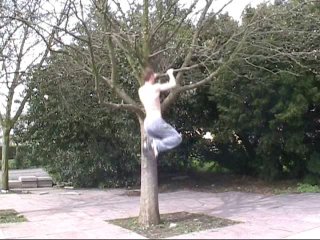
-When everyone is finished, we're all in the pushup position and whilst we're down there, we do 25 pushups.
-A quick jog around the corner and we climb up onto a roof with a slight overhang, 10 climbups here followed by a 1 minute hang straight after the last climbup. If you finish early, you wait in the pushup position for the rest of the group regardless of how long it takes for them to do 10 climbups and hang for a total of 60 seconds. The burn on this exercise is great!
-As soon as we're all done there, we move onto some parallel bike rails and do 1 dip, followed by 1 stomach crunch and repeat 10 times. By this point after the pushups, climbups and pullups, this can be quite testing on the triceps and chest...
-Straight from there onto two parallel blue rails in an L shape. We put our hands on one side and our feet on the other, and shimmy along until we reach the corner, from here we need to stretch out to the corner with our feet whilst keeping our hand in position until we end up on the other straight. Another shimmy uphill takes us to the end and we do this entire obstacle twice in a row without rest.
-Next up is a climb up a vertical lamp post to the top, touch the light and climb back down. This one proves particularly hard when it's raining!
-From there, onto a flat wall with a sharp edge, and we shimmy across the top of that to the other end, only 20ft or so. We climb down a drainpipe to the ground and wait in the pushup position for the others to catch up.
-Next up, we all start at the bottom of a flight of steep stairs on all fours, and climb up them backwards, when we reach the top we climb all the way back down again head first. If that wasn't enough fun, we climb all the way to the top once more, and all the way back down - again.
-Carrying exercises now, where we lift a partner on to our shoulders and run 200m as fast as we can, then we swap around and the other person does 200m with their partner on their shoulders.
-This next exercise is similar to the blue rail obstacle but this one is a lot longer. It's roughly 100m and the gap between your feet and hands gets bigger and bigger as you can see below. This is one hell of a great forearm workout! When you get near the end, no one is tall enough to reach with both hands and feet so we drop into the arm jump position and shimmy to the end that way.
-We wait in the pushup position until everyone is finished that then immediately crawl the length of those black rails to the other end.
-Back muscles and shoulders are now put to the test again when we climb horizontally along a series of 12 window ledges without touching the floor, takes about 4-5 minutes.
-Straight after it's muscle up time! We do a muscle up on a FAT bar (A) which is sometimes tough after the onslaught before, but once we've muscled up, we climb onto the bar and climb down a metal staircase underneath the stairs just using our arms (B).
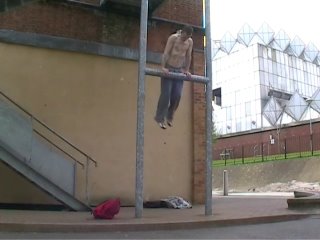
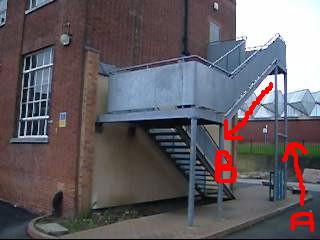
-Under the stairs we do more pushups, this time we take 10 seconds to do one pushup and pause halfway for a while, at the bottom we pause again, lean to our left hand, lean to our right, back to the centre and push back to the top, taking 10 seconds to get to the top. This is repeated for 5-8 minutes or so until our arms are shaking and we can taste our dinner again.... yum.
-Then we hang from the metal staircase and L sit for 20 seconds.
-Possibly the toughest exercise of the night now, it's 1 climbup on the bottom wall below, shimmy across to the other side of it at waist height, climb down into the arm jump position, climb up again, then climb down and repeat x 5. In total it's 10 flat wall climbups, with waist shimmying in between and after all the previous exercises, you really feel this one in the arms.
Next up we climb up some rails covering a window onto the edge of a roof and shimmy under some barbed wire then climb down another window ledge at the other end of the roof. On the photo below, the barbed wire had yet to be added to the roof.
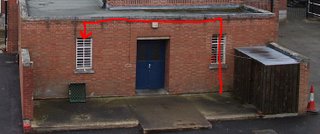
-Time to crawl again... after climbing up the outside of the stair case (or the inside if you have to), we crawl the length of the roof... near the other end there's some dips to do, so we do 10 whilst we're up there then crawl down an identical staircase on the other side of the building head first.
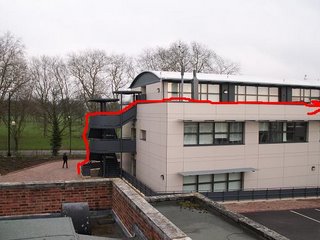
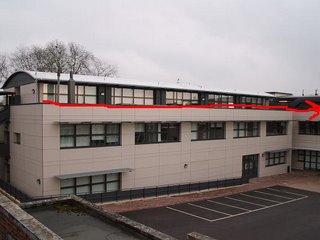
...and that's 1 lap, we then get a quick drink and run back to the start by the tree and begin the course again. We don't rest in between each exercise as we're waiting in the pushup position for people to finish so it really is a gruelling session of constant exercise. We usually only get through 3 laps of the course due to that taking around 4 hours to complete.
Although it was literally hell to begin with, the benefits of such harsh training is evident, everyone who regularly attends is now becoming comfortable with all of the above to a certain extent which is why I'm making it harder each and every week so we're always stepping out of our comfort zones.
Hell Night has helped us to become so much stronger and our stamina levels have shot up drastically. Everyone agrees that their Parkour has benefited from it immensely.
After the 4th or 5th week of Hell Night, my usual weekly training which I used to find tough, was not even causing me to break a sweat so it just shows how effective this kind of training is for your body.
The other benefit of this type of training is a mental one, since Winter is closing in, the nights have been very cold and dark and 3 of the weeks saw it raining for the duration of the session. You need to be prepared for this mentally and just accept that you are going to be pushing yourself to the limits regardless of the weather conditions.
I highly recommend starting your own Hell Night in your area... meet up once per week with some friends with the goal of completely breaking yourselves down and tiring yourselves out until you fail to function properly. Repeat this week after week and I promise it will change your body completely and give you so much more power and confidence in your Parkour.
Early in the new year I'll post the latest version of what we're doing with proper photos of one of the nights... we'll probably be using weighted vests for the exercises by then.
-Blane
We start the night at 7pm with a simple loosening up period just so we don't go into the first phase cold. Immediately after that we head to a nearby rugby field and run laps around it for a while until our blood's pumping and core temperature has raised...
We then walk another lap of the field whilst holding our arms out the sides, above us, and stretching them thoroughly.
Our first physical activity of the night is on the rugby posts - we climb up one side just using our arms, swing across the top, and climb down the other side only using our legs to generate momentum on the swing across the top.
A jog to the nearby war memorial and we spend 10-15 minutes here stretching thoroughly and preparing ourselves for the night to come. After everyone is ready and feeling loose, we walk to the other side of the university by the front gates. It's at this point we all split up and go our seperate ways, with the goal of getting back to the memorial in the quietest way possible. The emphasis is on silent movements and controlled muscle contractions especially on climbups, deep landings and crawling where necessary. Everything is controlled and speed is the least important part of this exercise. It usually takes everyone 15 minutes to get back to the start if they're really focusing on moving with minimal sound.
As soon as we're all back together the main phase of the night begins and everyone knows the easy parts are now finished. Everything from this point on is going to hurt.
This main phase changes every week and gets harder and harder as the weeks go on. I'll explain what week 6 consisted of...
-The group waits in the pushup position as each of us in turn jump up to a branch of a tree and do 10 pullups, grabbing a higher branch, lowering ourselves down to the bottom branch again slowly, and repeat until we've each done 10. Once a person completes this pullup challenge, they wait for the others once again in the pushup position.

-When everyone is finished, we're all in the pushup position and whilst we're down there, we do 25 pushups.
-A quick jog around the corner and we climb up onto a roof with a slight overhang, 10 climbups here followed by a 1 minute hang straight after the last climbup. If you finish early, you wait in the pushup position for the rest of the group regardless of how long it takes for them to do 10 climbups and hang for a total of 60 seconds. The burn on this exercise is great!
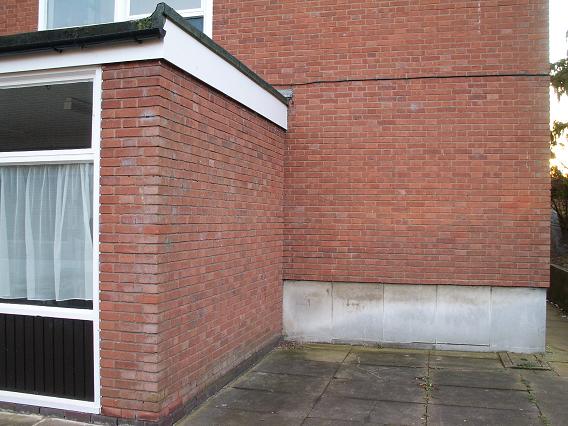
-As soon as we're all done there, we move onto some parallel bike rails and do 1 dip, followed by 1 stomach crunch and repeat 10 times. By this point after the pushups, climbups and pullups, this can be quite testing on the triceps and chest...
-Straight from there onto two parallel blue rails in an L shape. We put our hands on one side and our feet on the other, and shimmy along until we reach the corner, from here we need to stretch out to the corner with our feet whilst keeping our hand in position until we end up on the other straight. Another shimmy uphill takes us to the end and we do this entire obstacle twice in a row without rest.

-Next up is a climb up a vertical lamp post to the top, touch the light and climb back down. This one proves particularly hard when it's raining!
-From there, onto a flat wall with a sharp edge, and we shimmy across the top of that to the other end, only 20ft or so. We climb down a drainpipe to the ground and wait in the pushup position for the others to catch up.
-Next up, we all start at the bottom of a flight of steep stairs on all fours, and climb up them backwards, when we reach the top we climb all the way back down again head first. If that wasn't enough fun, we climb all the way to the top once more, and all the way back down - again.
-Carrying exercises now, where we lift a partner on to our shoulders and run 200m as fast as we can, then we swap around and the other person does 200m with their partner on their shoulders.
-This next exercise is similar to the blue rail obstacle but this one is a lot longer. It's roughly 100m and the gap between your feet and hands gets bigger and bigger as you can see below. This is one hell of a great forearm workout! When you get near the end, no one is tall enough to reach with both hands and feet so we drop into the arm jump position and shimmy to the end that way.
-We wait in the pushup position until everyone is finished that then immediately crawl the length of those black rails to the other end.
-Back muscles and shoulders are now put to the test again when we climb horizontally along a series of 12 window ledges without touching the floor, takes about 4-5 minutes.
-Straight after it's muscle up time! We do a muscle up on a FAT bar (A) which is sometimes tough after the onslaught before, but once we've muscled up, we climb onto the bar and climb down a metal staircase underneath the stairs just using our arms (B).
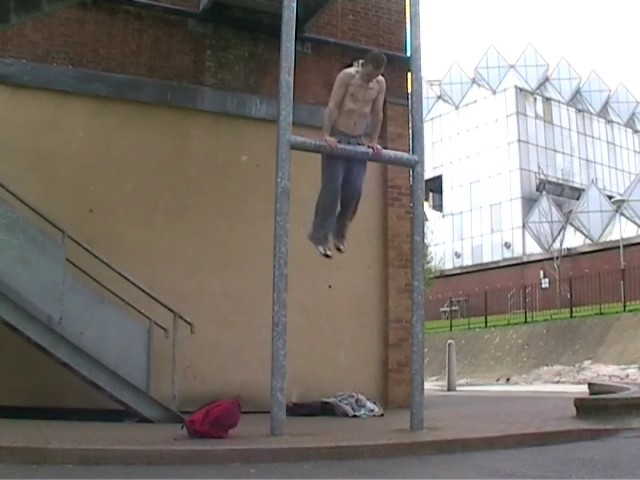
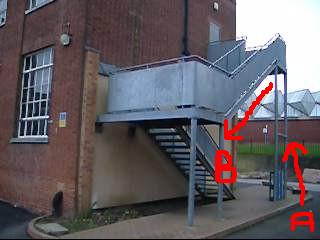
-Under the stairs we do more pushups, this time we take 10 seconds to do one pushup and pause halfway for a while, at the bottom we pause again, lean to our left hand, lean to our right, back to the centre and push back to the top, taking 10 seconds to get to the top. This is repeated for 5-8 minutes or so until our arms are shaking and we can taste our dinner again.... yum.
-Then we hang from the metal staircase and L sit for 20 seconds.
-Possibly the toughest exercise of the night now, it's 1 climbup on the bottom wall below, shimmy across to the other side of it at waist height, climb down into the arm jump position, climb up again, then climb down and repeat x 5. In total it's 10 flat wall climbups, with waist shimmying in between and after all the previous exercises, you really feel this one in the arms.
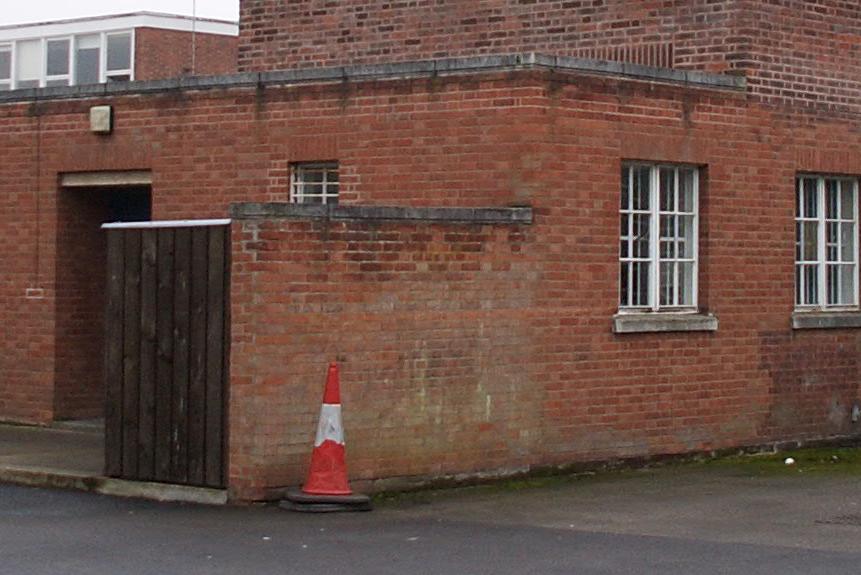
Next up we climb up some rails covering a window onto the edge of a roof and shimmy under some barbed wire then climb down another window ledge at the other end of the roof. On the photo below, the barbed wire had yet to be added to the roof.

-Time to crawl again... after climbing up the outside of the stair case (or the inside if you have to), we crawl the length of the roof... near the other end there's some dips to do, so we do 10 whilst we're up there then crawl down an identical staircase on the other side of the building head first.

...and that's 1 lap, we then get a quick drink and run back to the start by the tree and begin the course again. We don't rest in between each exercise as we're waiting in the pushup position for people to finish so it really is a gruelling session of constant exercise. We usually only get through 3 laps of the course due to that taking around 4 hours to complete.
Although it was literally hell to begin with, the benefits of such harsh training is evident, everyone who regularly attends is now becoming comfortable with all of the above to a certain extent which is why I'm making it harder each and every week so we're always stepping out of our comfort zones.
Hell Night has helped us to become so much stronger and our stamina levels have shot up drastically. Everyone agrees that their Parkour has benefited from it immensely.
After the 4th or 5th week of Hell Night, my usual weekly training which I used to find tough, was not even causing me to break a sweat so it just shows how effective this kind of training is for your body.
The other benefit of this type of training is a mental one, since Winter is closing in, the nights have been very cold and dark and 3 of the weeks saw it raining for the duration of the session. You need to be prepared for this mentally and just accept that you are going to be pushing yourself to the limits regardless of the weather conditions.
I highly recommend starting your own Hell Night in your area... meet up once per week with some friends with the goal of completely breaking yourselves down and tiring yourselves out until you fail to function properly. Repeat this week after week and I promise it will change your body completely and give you so much more power and confidence in your Parkour.
Early in the new year I'll post the latest version of what we're doing with proper photos of one of the nights... we'll probably be using weighted vests for the exercises by then.
-Blane
Friday, November 03, 2006
Past, Present and Future
After following Jin's advice, I've decided to create a blog to let everyone know what I'm up to, how my training is going and what my current thoughts and goals are. It will also be a good place for me to record my progress and look back on in time to come.
Since this is my first entry to the blog I'll bring you all up to speed with a fairly lengthy entry...
A few months ago after almost 3 years of training in Parkour I hit a plateux and noticed a significant invisible wall that I seemed to run in to and couldn't get past. My technical ability had come across a barrier and I realised that if I were to further progress technically, I had to first change the very thing that was limiting me - my body.
Over the past three months I've transformed my body and seriously pushed the envelope in terms of muscular endurance, power, speed and stamina. It was difficult to almost completely stop technical training (with the exception of balance and drilling the basics) and dedicate so much time to physical development but it has been worth it and the gains are now obvious.
I'm at a stage where I feel very confident in my self and I'm now easing back into the technical side of the discipline. I don't doubt there will be a transition period where I'll need to refresh my memory in some of the finer details of technical movements but I know this will be a quick process and that I'll surpass my old stale state very quickly with the added strength.
One major contributor to the maintenance of my condition is 'Hell Night' - a weekly session that I started when I realised that there were more traceurs in Leicester who really wanted to knuckle down and put their bodies through hell to achieve a higher level in Parkour. We meet up every Thursday night at 7pm and train for about 4 hours in non-stop parkour-orientated conditioning and isometric resistance work. It's also very mentally challenging due to the winter months rolling in, it's been very wet, cold and damp but this only adds to its appeal and difficulty so there's never any complaints. Come snow, hail, wind and rain, we will be out in force facing the elements in a battle to progress. Now only six weeks old, the course is becoming harder each week with less rest in between each set, a faster pace and more reps thrown into the exercises.
To track our progress I'm updating a spreadsheet every week with a list of everyone who turns up, how many laps of the course we do, what specific exercises we concentrate on and any other details such as warm-ups, dates and notes, it will be very interesting to look back on in six months time to see how much it has helped us.
I'll cut off there and give your eyes a rest, check back here soon for updates including:
-My current weekly training regime
-More details on the specifics of Hell Night
-What I'm focusing on to push my technical ability
Until then; train hard, eat well and rest.
Subscribe to:
Posts (Atom)